MIT Applied AI & Data Science Associate Program — Curriculum Completion
From August 2025 to March 2026 I completed the MIT Applied AI & Data Science associate program — a six-month, hands-on, project-driven curriculum run by MIT Professional Education together with Great Learning. View my MIT credential.
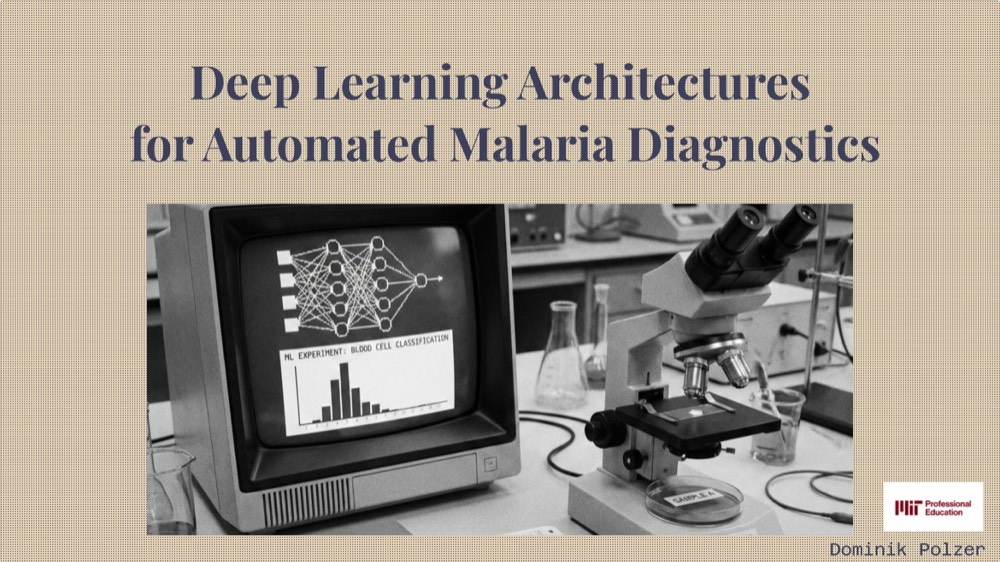
Capstone Project — Deep Learning: Malaria Detection
This project uses deep learning to automatically detect malaria from images of red blood cells. A Convolutional Neural Network (CNN) is trained to classify each cell as either parasitized or uninfected. The goal is to reduce manual work, lower human error, and help deliver faster and more accurate malaria diagnosis.
It was a fully hands-on build — training models from scratch with Keras and TensorFlow, starting from exploratory data analysis (EDA) of the cell-image dataset, through data augmentation, custom CNN architectures, and iterative tuning. No pre-baked pipelines: I built, broke and rebuilt the models myself to understand every layer of the workflow.
Results & learnings
After a lot of experimentation and custom model building, I finalized a model reaching 97% accuracy for malaria detection in red blood cells.
- Hands-on training from scratch with Keras / TensorFlow.
- EDA and preprocessing of the red-blood-cell image dataset.
- Designing and comparing custom CNN architectures, then tuning to push accuracy.
I presented the final results to MIT & Great Learning. You can view the final capstone presentation here.
Other projects from the program
Alongside the capstone, the program included a couple of smaller, hands-on projects.
Street View Housing Number Digit Recognition — Deep Learning (elective)
A deep-learning solution to recognize digits from real-world street images using the SVHN dataset
(in .h5 format). A subset of the data was used to reduce computation time. I designed, trained,
compared and evaluated multiple ANN and CNN models to select the best performer for accurate
digit prediction.
Skills & tools: Deep Learning · ANN · CNN · Image Classification · Computer Vision · Model Evaluation.
My final report (HTML) can be downloaded here (Oct 2025).
FoodHub Data Analysis — Foundations of Data Science
An exploratory data analysis (EDA) project on FoodHub’s food-delivery data to understand customer ordering behaviour, restaurant popularity, and delivery efficiency in New York — examining order cost, food preparation time, delivery time, and customer ratings across weekdays and weekends. The insights help FoodHub improve delivery speed, restaurant performance, and overall customer experience.
Skills & tools: Python · Pandas · Data Cleaning & Descriptive Statistics · EDA · Data Visualization.
My learnings and EDA analysis (HTML) can be downloaded here.